Life events · Timely organisation

The best time to start is the moment something changes.

Moving home, changing jobs or welcoming a child can create new accounts, policies and important documents. SuccessionKeeper helps you capture what changed and where it is held while the details are still easy to find.

No card required

About 2 minutes to start

No bank or provider passwords stored

A couple sorting paperwork at a laptop among moving boxes in a new home

Key life triggers

Why life changes are a good time to get organised

The paperwork is visible

Mortgage documents, policy schedules, pension letters and forms are easier to record while they are still current.

Your nominees may change

Marriage, children, family illness and bereavement can change who should be a nominee.

Details become harder to reconstruct over time

Previous employers, old addresses and former providers are much easier to identify now than several years later.

Life events often make the need clearer

39%

of people surveyed had personally struggled to locate a loved one’s financial information during illness, bereavement or an emergency, or had watched someone close struggle.

66%

of those who personally went through the search say getting the family’s financial information organised is urgent or something they know they need to address.

84%

of the same group said a secure family-information platform would be useful.

SuccessionKeeper UK Financial Preparedness Survey 2026, 1,006 UK adults, June 2026. Results unweighted. See the research and methodology →

Key life triggers

What financial information should you review after a major life event?

Life changes often bring new accounts, documents and responsibilities. Choose the change that fits your life now. We will show you what is worth recording while the details are still easy to find.

Select a life event. A practical explanation and checklist will appear below.

Changing jobs

What happens to your workplace pension when you change jobs?

Your workplace pension normally remains yours after you leave your employer. If you stop contributing, the money will usually remain invested unless you later transfer it or take another action permitted by the scheme.

Changing jobs is therefore a useful moment to record the provider, scheme and former employer while the paperwork is still familiar and easy to find.

Work bag, notebook and desk ready for a new role

How SuccessionKeeper fits

Record the provider, pension type, former employer and any optional reference details. SuccessionKeeper keeps the map of where the pension is held; it does not connect to the scheme or store provider login credentials.

What to record now

Former employer

Pension provider or scheme name

Member or reference number, if known

Approximate employment dates

Where pension documents are held

Why it may matter later

Older providers can become harder to remember

Employers and schemes can change names

A family member or executor first needs to know which scheme to contact

Keeping the employer and provider together preserves useful context

40%

of respondents had paid into two or more pension pots during their careers. Among people with multiple pots, 77% had not fully consolidated them.

This is not a recommendation to consolidate pensions. The practical point is to keep a record of where each pension is held.

Related guide: How to find old or lost pensions in the UK →

General information for UK users.

Back to life events ↑

Buying a home

What financial information should you keep after buying a home?

A home purchase can create several important financial relationships at once, including a mortgage, buildings insurance and new ownership documents.

Recording the key providers, references and document locations while the transaction is fresh can prevent the information becoming scattered across inboxes, portals and paper files.

Front door, keys and moving box at a new home

How SuccessionKeeper fits

Record the lender, relevant insurance, document locations and the professionals involved. You do not need to upload everything or store passwords.

What to record now

Mortgage lender and reference

Title or ownership information

Buildings insurance provider and policy

Relevant life cover

Solicitor or conveyancer contact

Why it may matter later

Property records often sit separately from everyday financial accounts

Insurance and mortgage details may be needed years later

Professional contacts can help explain where documents originated

A move can change addresses across several providers at once

Keep the record focused on what exists and where it is held.

Back to life events ↑

Getting married

What financial information should you review after getting married?

Marriage is a useful point to review your will, pension nominations, insurance, beneficiaries and how financial information is shared between you.

Two financial lives do not automatically become one clear record, so it is worth checking whether each person would know where the other person’s important accounts and documents are held.

Wedding stationery, rings and flowers

How SuccessionKeeper fits

SuccessionKeeper can provide a separate record of where each person’s financial information is held without requiring couples to merge accounts or share provider passwords.

What to review

Location of your will

Pension nominations

Life insurance beneficiaries

Joint and individual accounts

Solicitor, adviser or accountant contacts

Why it may matter later

Each person may still have accounts the other does not know about

Existing nominations and policies may need reviewing

Provider details can remain separate even where household finances are shared

A clear starting point can make future administration easier

Legal effects of marriage vary across UK jurisdictions, so legal questions should be checked with an appropriate adviser.

Back to life events ↑

Having a child

What financial information should you review after having a child?

A new child often changes who depends on you and may prompt changes to your will, guardianship arrangements, pension or insurance nominations, savings and cover.

It is also a useful moment to make sure somebody else could understand what arrangements already exist and where the supporting information is held.

Nursery items prepared for a new baby

How SuccessionKeeper fits

Use the record to show where important accounts, policies and documents are held. SuccessionKeeper does not replace legal advice on guardianship, wills or estate planning.

What to review

Your will and any guardianship arrangements

Pension and insurance nominations

Child savings or investment accounts

Life cover

Trusted family and professional contacts

Why it may matter later

More people may depend on arrangements you already have

Important records may sit with different providers

Someone stepping in may need to know what has already been arranged

Capturing the information now can reduce guesswork later

58%

of parents of children under 18 said getting the family’s financial information organised was urgent or something they knew they should address. 84% said a secure family-information platform would be useful.

SuccessionKeeper UK Financial Preparedness Survey 2026.

Review the practical record alongside any professional legal or financial advice you take.

Back to life events ↑

Helping a parent get organised

How can you help a parent get their financial affairs organised?

If a parent wants help, the clearest information usually comes directly from them while they can still explain which providers they use, where documents are kept and who their professional contacts are.

The aim is not to take control. It is to help create a practical record of what exists and where it is held while the information is easy to verify.

Adult child helping older parents review paperwork at home

How SuccessionKeeper fits

The account holder remains in control of their own information. SuccessionKeeper does not replace a power of attorney or give another person authority over finances.

What may be useful to record

Accounts and providers

Pensions and insurance

Will and power of attorney documents

Adviser or solicitor contacts

Property and important household records

Why it may matter later

Family members may otherwise have to reconstruct the picture

Provider names and document locations can be difficult to infer

Professional contacts may hold useful context

A clear record can reduce unnecessary searching

Related guide: How to talk to ageing parents about money, wills and financial accounts →

The account holder should remain in control of what is recorded and shared.

Back to life events ↑

After a bereavement

What financial information is most useful after a bereavement?

The most useful starting point is a clear record of which accounts, pensions, insurance policies, documents and professional contacts exist and where they are held.

Sorting out someone else’s affairs often makes information gaps visible. That experience can also show you exactly which details your own family would struggle to reconstruct.

Family photograph and important documents on a home table

How SuccessionKeeper fits

Use the experience to identify what your own family would need to know about you. You do not need to recreate somebody else’s estate inside SuccessionKeeper.

What to capture while it is fresh

What was difficult to trace

Your own provider list

Important document locations

Professional contacts

Context your family would otherwise have to guess

Why it may matter later

Small missing details can create disproportionate work

Experience shows which information was actually useful

Capturing your own information can prevent the same problem recurring

A clear starting point can make estate administration less uncertain

20%

of respondents who personally struggled to locate a loved one’s financial information said they were not even sure what accounts or assets existed. Their average stress score was higher than the rest of that group.

SuccessionKeeper UK Financial Preparedness Survey 2026.

Related guide: How to find financial accounts after death in the UK and prevent them becoming unclaimed →

This section is practical information, not bereavement or legal advice.

Back to life events ↑

Writing or updating a will

What financial information should you keep alongside a will?

A will can set out how you want your estate dealt with, but the people handling your affairs may still need to identify which accounts, pensions, policies and documents exist and where they are held.

A practical financial record complements the legal document by giving executors and family members a clearer starting point.

Will and estate planning documents arranged on a desk

How SuccessionKeeper fits

SuccessionKeeper complements a will by recording the practical financial map. It does not replace the will or legal advice.

What to record alongside your will

Location of the original will

Executor details

Accounts, pensions and policies

Solicitor contact

Supporting documents

Why it may matter later

A will may not list every provider or account

Executors still need to identify the organisations involved

Knowing where documents are held gives them a practical starting point

The legal document and the practical record solve different problems

42%

Even among respondents who already had a will, only 42% said it would be very easy for their partner to locate all their accounts and documents.

SuccessionKeeper UK Financial Preparedness Survey 2026.

Related guide: Death file checklist UK: what to record and why it matters →

A will and a financial inventory serve different purposes.

Back to life events ↑

Retiring

What financial records should you update when you retire?

Retirement can change which pensions you draw from, which providers you use and where your financial information is held.

It is a natural point to make the record match the new financial picture, especially where pensions or insurance arrangements have moved or changed.

Calm home scene marking a later-life transition

How SuccessionKeeper fits

Update the map when providers, pension arrangements or account details change. SuccessionKeeper does not recommend whether pensions should be transferred, consolidated or drawn.

What to update

Pensions now in payment

Drawdown or annuity providers

Consolidated or moved accounts

Insurance changes

Adviser contacts

Why it may matter later

Providers may change as pensions are accessed or moved

Older workplace pensions may remain alongside newer retirement products

An updated record makes the post-retirement picture easier to understand

Professional contacts may become more important at this stage

This is record-keeping guidance, not pension or investment advice.

Back to life events ↑

Check-ins and controlled release

Your record can change as your life changes

Update anything at any time

Change providers, references, notes or documents whenever something changes.

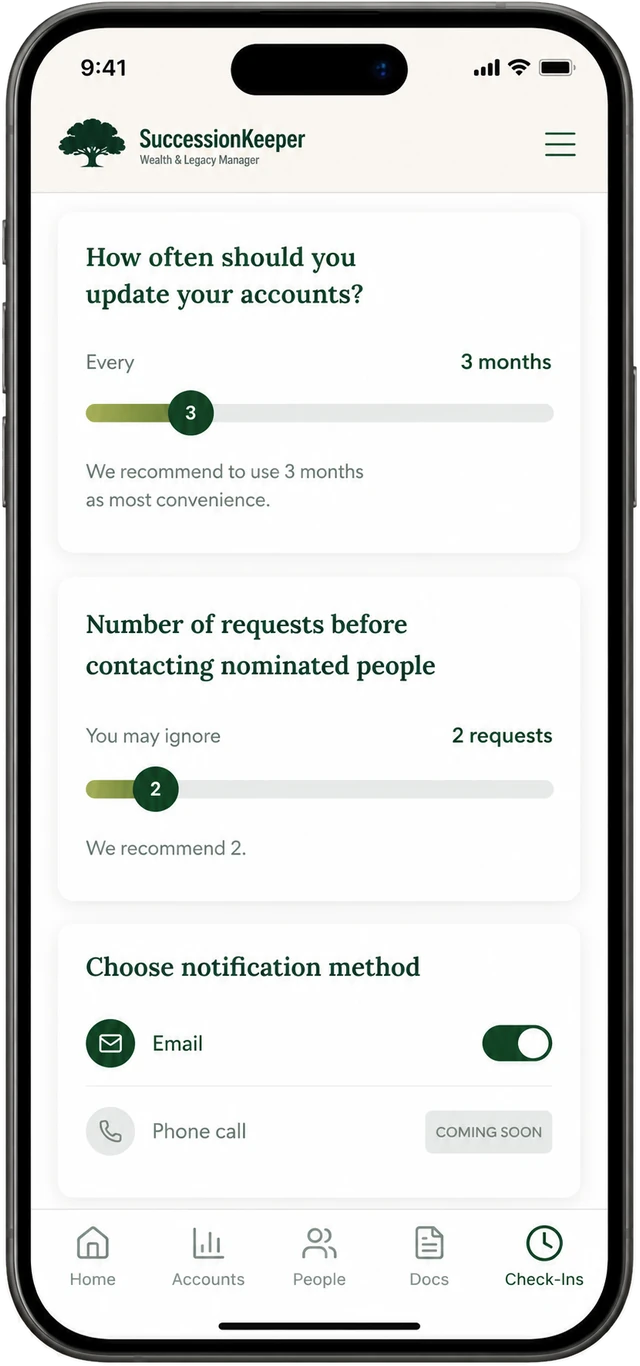
Use check-ins as a reminder to review

Choose how often SuccessionKeeper checks in with you, giving you a natural prompt to keep the record current.

Change your nominees when life changes

Update the people you have chosen whenever your circumstances or relationships change.

See how controlled release works →

Every nominee you include receives the same structured summary, never a login.

SuccessionKeeper check-in settings on a phone

Common questions

Frequently asked questions about life events

When should I review my financial information?

Review it whenever something significant changes, such as changing jobs, moving home, getting married, having a child, retiring or changing a financial provider. You do not need to rebuild the whole record each time. Focus on what changed.

Do I still need a financial record if I have a will?

A will and a financial inventory serve different purposes. A will can set out your wishes for your estate, while a financial record helps the people involved identify what exists, where it is held and which organisations may need to be contacted.

Do I need to update everything after a life event?

No. Start with the accounts, policies, documents or contacts affected by the change. SuccessionKeeper is designed to be updated over time, so the record can grow with your financial life.

What if my life event is not listed here?

The same principle applies. If a change creates, removes or alters an account, policy, property interest, important document or trusted contact, it is a useful time to review your record.

What financial information is most useful to record?

Start with what exists and where it is held: provider names, account or policy types, relevant contacts and document locations. Reference numbers and additional details can be added where useful.


Get started

Start with the change in front of you. A small step now can make the next change easier.

You do not need to organise everything at once. Add one account, pension, policy or document now, then update the record as life changes.

Unlimited accounts and assets

Unlimited nominees, one of them your primary

Download or delete your data anytime

One plan. Everything included.

£4a month

or £39 a year (saves £9)

Start your free 14-day trial

14-day free trial · No card required · Cancel anytime

SuccessionKeeper provides record-keeping tools and general information. It does not provide financial, tax or legal advice.